Showing posts with label Food. Show all posts

Wednesday, November 27, 2013

The Foods That Founded America part three: Winter Squash


Pumpkin for breakfast
Pumpkin at noon
Without Pumpkin
We'd be undoon

Rhyme from the colonies
 
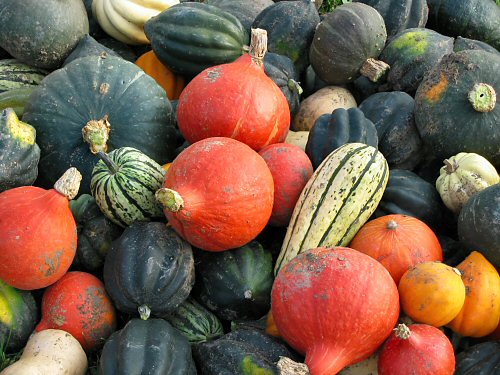
Winter squash was first discovered in America and was already a staple of the native American diet when the first colonists arrived.  What a boon to the inexperienced colonists. It is easy to grow, harvest, and store for the winter.  There are hundreds of varieties with every possible size, favor, and color.  There are blue Hubbard's that get over 60 lbs and tiny sweet dumplings that are the perfect serving size. 

 
The above poem shows how dependant the colonists were on pumpkin.  In one journal a visitor noted that the people ate pumpkin at every meal.  And really winter squash can be used in so many ways.  They can be turned into soups, pies, breads, roasted, dried, pickled, mashed, and even fermented.   They are a high quality food with lots of vitamins and nutrition.

They require little effort to preserve for winter as you can store them for up to six months in a moderately warm room.  You can also simply slice them and dry them till leathery and add them to soups later.

Add to all its other virtues winter squash makes a good winter animal fodder.  Many farmers used pumpkins to feed their cows, goats, sheep, and pigs until spring.  

As America grew up and expanded the settlers brought their favorite squash seeds with them to plant at their new homes.  Often it was the best harvest they had that first year on the new broken land since grain crops did poorly on the fresh turned land.

Now winter squash is a traditional part of the American diet.  Pumpkin pie is the most common dish at a holiday table, but roasted squash and squash soup are often served on the fall table.

Our family loves roasted butternut, buttercup, and sweet dumpling squash with dinner. I often make pumpkin bread, muffins, and cake.  This year for us was somewhat like it must have been for the settlers of early America.  Our garden was new in many areas of our land and the pumpkins, winter squash, and summer squash did the best out of all our endeavors.


Amish Sugar Pie Pumpkins from our garden


What a Colonial Kitchen Looked Like

Colonial Pumpkin Pie


2 cups mashed cooked pumpkin or (16 oz. can of pumpkin)

3/4 cup sugar

2 teaspoons ground cinnamon

3/4 teaspoon ground nutmeg

1/4 teaspoon ground cloves

1/2 teaspoon salt

3 slightly beaten eggs

1 cup light cream

1 unbaked 9 inch pie shell


Combine pumpkin, sugar, spices and salt. Blend in eggs and cream. Pour into pastry shell. Bake at 400 until knife inserted off center comes out clean. 40 to 50 minutes. Cool (filling may crack)

Pumpkin Gingerbread Cake

My family loves this cake turned into cupcakes.  It makes a huge sheet cake so be prepared!  Also try grinding your own spices, they are much more fragrant and flavorful fresh ground.  I use an electric coffee grinder.

3 c. sugar
1 c. oil
4 eggs
2/3 c. water
15 oz. canned pumpkin
2 t. ground ginger
1 t. cinnamon
1 t. allspice
1 t. nutmeg
1 t. ground cloves
3-1/2 c. all-purpose flour
2 t. baking powder
2 t. baking soda
1-1/2 t. salt
Garnish with whipped cream

Beat together sugar, oil and eggs.  Add water, mix well.  Beat in pumpkin and spices, set aside.  In a separate bowl, combine flour baking soda, baking powder and salt.  Stir into pumpkin mixture just until dry ingredients are moistened.  Pour into a greased 13"x9" baking pan; bake at 350 degrees for about 45 minutes, until a toothpick tests clean.  Cool slightly.  Serve warm or cold, garnish with whipped cream.  Serves 12

Sunday, November 17, 2013

The Foods That Founded America: Part Two- The Forgotten Pig


Ahhh the pig.  What an unsung hero of the American founding she is!  We hear more about the turkey than the pig when, in  reality, the pig has done more for the colonists and pioneers than any other animal. But first I must clarify for my honored readers the great difference between the modern pig and her more rustic predecessor who was used by the colonists and pioneers. A little pig history if you will.

Up until about 100 years ago the pig served a much different purpose than it does today.  The pig in essence was a fat factory, its main purpose was to make lots and lots of fat.  Why fat you say?  Well before the industrial revolution there was no such thing as petroleum products or electricity.  So all soaps, candles, and oil had to come from animal fats.  Trying to farm oil producing crops was not yet possible for the average farmer due to the fact that one man and a team of oxen could only farm so much land a year.  So where could a reliable source of good quality lard and tallow come from?  Cows have a lot of fat but take at least two years to reach butcher weight and require lots of hay and pasture to get there.  Chickens produce fat but it is too soft for good soap or candle production.  However the pig is glorious in its capacity to put on loads of nice hard fat in less than a year.


For the early Americans pigs were absolutely essential to life.  They were easy to care for, ate waste foods and rooted for themselves, and reproduced in abundance.   They provided the fat necessary to make lye soap, candles, and lard for cooking as all products not produced at home had to be shipped in at astronomical expense and unreliable transportation.  Pounds and pounds of soap had to made every year to provide the family with something to clean laundry and themselves with.  Lard was used to bake and fry foods with, and also as a form of preservation.  Housewife's would make dozens of mince pies in fall after hog killing and then pour rendered lard on top of the pie crust thus sealing it against air.  Then they would be placed into a secure unheated room where it promptly froze.  The first frozen food!  Candles were considered a luxury so most of the lard went into soap or food production.   When the colonists first arrived on the northeastern shores they stared in dismay at a vast forest with no seeming end.  In fact this became known as the Great Forest, and it stretched from the furthest north of Canada down to Florida and from the edge of the east coast all the way to the Dakotas.  This may seem to us as a good thing but the colonists were a bit more practical.  With out any valleys for grass hay a cow, ox (the preferred animal for hauling) or horse couldn't survive.  In fact grass seed had to be brought to the colonies because the little grass growing on the eastern seaboard was so low in nutrition.  One horse goes through at least a ton of good grass hay a winter, and needs ample pasturage from spring through fall.  A milk cow requires the same. So that meant that for almost 15 years very few people had these animals until they could clear enough forest and as an extension there was very little butter for cooking and baking.  Rendered lard was happily adopted.

 
 None of the colonists were hunters as wild game was almost extinct in Europe and what there was left was jealously guarded by the aristocracy.  Luckily most of the colonists brought pigs and goats with them.  Goats are more like deer in their eating requirements and took to the forests like ducks to water so at least milk was available.  The pigs themselves were so well adapted to the forests that they must have been a great blessing.  Soon after the first colonist arrived half wild pigs began taking over the forest.  For those who are not blessed with a love of pigs I should tell you that they have a wild sense of adventure and love nothing more than to break the chains of civilization and go off on their own to conquer the wilderness.  Soon wild pigs became so common that most colonist didn't even bother keeping them.  They just went out into the forest and killed a few and then brought them home.  Numerous reports indicate that they were a dangerous pest.  Many people were attacked and children were frequently killed by them.  Numerous laws were enacted to try and solve the problem.


Feral Hog
It is surprising to most people that pigs were able to survive the harsh northeastern winters.  But this is because we still have that pesky mental picture of the modern pig in our minds.  The pigs of yesteryear were huge, with a fat layer sometimes 6 inches or more thick.  They were covered in a thick coat of hair and were generally not pink but brown, black, or spotted and they had teeth and tusks that could rip an enemy to pieces. Kind of scary huh?  A good hog could reach over 2000 pounds.  Imagine that coming at you in the middle of the night!  The pigs had ample food in the Great Forest as almost 50% of the trees were oak.  They laid down literally feet thick layers of acorns every fall, and as any foodie can tell you the best pork comes from acorn fattened hog.  This food source was good even in the depths of winter as nuts don't decompose or rot easily.  All the pigs had to do was root for it.  Ahhh the good old days!

As the westward expansion grew pork became even more important.  For most pioneers side pork ( a slab of really thick cured bacon) was their only meat besides what they could get in the wild, and was also the fat they used for frying.  Lard was used in place of butter on pancakes and biscuits.  Bacon, cornmeal, and beans formed the main diet for most of the people.


As farmers grew more prosperous pork still remained an important part of the American diet, and sausage making is still an annual tradition in rural America.  Pigs were as important to the founding of our nation as any other food and perhaps more so because they also provided light and cleaning agents.  So this Thanksgiving we should thank God for the pig!

Tuesday, December 21, 2010

Three Things I Have just Discovered that Are Yummy!

Some things I have found at the local grocery store that are very yummy.

Cold Stone Creamery Hot Cocoa Mix


This is so rich and creamy.  They use real dehydrated milk in it instead of milk byproducts like other cocoa mixes.  Also a great price at $1.99 a box


Better Oats Oat Revolution


This is like Quaker instant oatmeal.  It comes in many flavors including Cinnamon Strudel Muffin, peaches and cream, strawberries and cream.  This is much better that the Quaker variety.  Princess in Waiting tried it and loves oatmeal now, which she never would do before.  These were on sale at several different stores at $1.00 a box.